There are several traditional cures for sprains. Bathing with vinegar was said to be effective, as was rubbing the sprain with liniment made from olive oil and grated garlic. Rose water, lavender oil and witch hazel were used to reduce swelling, while an older cure involved applying the beaten white of an egg to the sprained area.
Comfrey was noted for its healing powers, and poultice of comfrey was used on sprains. Plantain was also noted as an effective wound healer, and its crushed fresh leaves were used on sprained ankles and other sprains.
Plantain was also used as one of the ingredients in a more complex remedy. The leaves of elder, ground ivy, wormwood and plantain were chopped and mixed with lard. The mixture was then put in a slow oven until the leaves were crisp and then the mixture was strained through linen.
Another cure for sprains involved warming three parts elder leaves to four parts lard and two parts grated suet. After the lard mixture had turned green, it was strained to linen before being applied to the sprain.
The leaves of tansy were also thought to relieve sprains. These were applied in the form of poultice.
Wednesday, July 30, 2008

Stiffness
A remedy for stiffness occurring after exercise involved soaking in the hottest bath that could be tolerated for at least ten minutes. Then a little camphorated oil was rubbed on the skin and kneaded into the muscles then salicylate of soda was taken in a glass of water before going to bed.
Stings and Bites
The Romans used peppermint to bring relief to insect bites and stings. Later a whole variety of natural substances were used in folk medicine for this purpose.
The crushed fresh leaves of several plants were used to rubbed to the infected part. These included parsley, plantain and balm. The leaves of flowers of marigold could be crushed and applied to the bite or sting. The leaf of the broad-leaved dock was a traditional remedy for nettle stings, dock handily often being found where nettles grow.
Crushed garlic or garlic macerated in oil was rubbed on insect bites or sting, and a cut leek could be also be used for this. Onion juice was rubbed on animal bites.
Sage tea applied to bites and stings was also thought to bring relief, as was a poultice made with cabbage. Cinnamon, oil of cardamom and oil of lavender were also used. Vinegar and witch hazel were another two possible remedies.
In the case of the sting of bees, wasp and hornets, it was advised to extract the sting and to apply ammonia or bicarbonate of soda (baking soda). These were also recommended for the bites of ants, gnats and mosquitoes.
Another cure for bee stings was to remove the sting and then put a cold compress on it, followed by a hot compress. An alternative remedy was to cover the affected area with damp cold soil.
Yet another cure for bee stings involved rubbing a little olive oil on the affected area. If this did not work, a poultice was to applied. Honey applied to an area stung by a bee was thought to be effective.
St. Jacob's oil was recommended in one cure for hornets stings. One cure recommended for anyone bitten by an adder was more complicated. It involved taking nine cloves of garlic and peeling them carefully. A spoonful of treacle and two pints of new strong ale were then added and mixed well. The patient was encouraged to drink freely of this mixture. He or she was to be well wrapped up while taking the cure to encourage perspiration.
The crushed fresh leaves of several plants were used to rubbed to the infected part. These included parsley, plantain and balm. The leaves of flowers of marigold could be crushed and applied to the bite or sting. The leaf of the broad-leaved dock was a traditional remedy for nettle stings, dock handily often being found where nettles grow.
Crushed garlic or garlic macerated in oil was rubbed on insect bites or sting, and a cut leek could be also be used for this. Onion juice was rubbed on animal bites.
Sage tea applied to bites and stings was also thought to bring relief, as was a poultice made with cabbage. Cinnamon, oil of cardamom and oil of lavender were also used. Vinegar and witch hazel were another two possible remedies.
In the case of the sting of bees, wasp and hornets, it was advised to extract the sting and to apply ammonia or bicarbonate of soda (baking soda). These were also recommended for the bites of ants, gnats and mosquitoes.
Another cure for bee stings was to remove the sting and then put a cold compress on it, followed by a hot compress. An alternative remedy was to cover the affected area with damp cold soil.
Yet another cure for bee stings involved rubbing a little olive oil on the affected area. If this did not work, a poultice was to applied. Honey applied to an area stung by a bee was thought to be effective.
St. Jacob's oil was recommended in one cure for hornets stings. One cure recommended for anyone bitten by an adder was more complicated. It involved taking nine cloves of garlic and peeling them carefully. A spoonful of treacle and two pints of new strong ale were then added and mixed well. The patient was encouraged to drink freely of this mixture. He or she was to be well wrapped up while taking the cure to encourage perspiration.
Saturday, July 26, 2008
Stitch
One old cure for a stitch in the side involved applying to the affected side a mixture of treacle mixed with very hot potato.
Treacle was also used in a more complicated and less pleasant cure. A gallon of new ale was mixed with as much of the dung of a stallion as would make a thick mixture. A pound of treacle, some sliced ginger and some saffron were then added. It was then put in a cold still before the mixture was administered, three or four spoonfuls at a time, to the person suffering from stitch.
Treacle was also used in a more complicated and less pleasant cure. A gallon of new ale was mixed with as much of the dung of a stallion as would make a thick mixture. A pound of treacle, some sliced ginger and some saffron were then added. It was then put in a cold still before the mixture was administered, three or four spoonfuls at a time, to the person suffering from stitch.
St. John's Wort

St. John's wort is also known as fairy herb.
In folklore the herb was used to keep at bay witches, ghosts and demons. It was also thought to have the power to protect a house from lightning.
Early herbalists used St. John's wort in the treatment of insanity and melancholy. It was later used against hysteria.
It was used in treatments of hemorrhages and in the spitting up of blood. Intestinal worms were treated with it, and it was given to children to stop them from bed-wetting
Externally it was used to treat skin irritations and bruising. It was also used to soothe engorged breast in nursing mothers.
Stomach Pains
The application of heat has long been thought to have a therapeutic effect on abdominal pain or cramps. Hot fomentations were once recommended. This involved pouring boiling water over a piece of flannel or other cloth, wringing cloth out to get rid of as much water as possible and applying it to the area to be treated, in this case the abdomen. The hot cloths has to be replaced as soon as they began to get cool, and it was recommended that a piece of flannel or a pad of cotton wool was placed over the treated area to prevent a chill. Hot bran was sometimes used as a somewhat messier alternative.
Heat is still thought to be therapeutic in cases of abdominal pain, or at least known to be a source of comfort to the sufferer. Nowadays, however, it is usually applied in more efficient manner, the patient clutching a hot-water bottle to the abdominal area or soaking in a hot bath.
Peppermint was thought to be instrumental in curing abdominal pain and spasm. Parsley, thyme, sage, cloves, chamomile and meadowsweet were thought of as cures in that they reduced spasm.
Various suggested remedies involving some kind of potion have been suggested over the centuries for this painful common disorder. In one of theses remedies a pint of milk was heated and given to the patient after four tablespoons of brandy have been added to it.
Another involved boiling a handful of betony in white wine, straining this and giving it to the patient to drink. A hot drink containing cinnamon is another traditional remedy, and a mixture using parsley seeds was sometimes administered.
A traditional charm to keep abdominal pain and colic at bay was a hare's foot with the joint still in it. One of the people who believed that carrying such a charm would keep him pain-free and flatulence-free was the seventeenth-century diarist Samuel Pepys.
Heat is still thought to be therapeutic in cases of abdominal pain, or at least known to be a source of comfort to the sufferer. Nowadays, however, it is usually applied in more efficient manner, the patient clutching a hot-water bottle to the abdominal area or soaking in a hot bath.
Peppermint was thought to be instrumental in curing abdominal pain and spasm. Parsley, thyme, sage, cloves, chamomile and meadowsweet were thought of as cures in that they reduced spasm.
Various suggested remedies involving some kind of potion have been suggested over the centuries for this painful common disorder. In one of theses remedies a pint of milk was heated and given to the patient after four tablespoons of brandy have been added to it.
Another involved boiling a handful of betony in white wine, straining this and giving it to the patient to drink. A hot drink containing cinnamon is another traditional remedy, and a mixture using parsley seeds was sometimes administered.
A traditional charm to keep abdominal pain and colic at bay was a hare's foot with the joint still in it. One of the people who believed that carrying such a charm would keep him pain-free and flatulence-free was the seventeenth-century diarist Samuel Pepys.
Wednesday, July 23, 2008
Stomach Problems
Many herbs were used in the treatment of stomach complaints. These included angelica, basil, caraway, centaury, chicory, comfrey, fennel, garlic and groundsel. Kidney-wort, knotgrass, marigold, marjoram and meadowsweet were also used as remedies for stomach problems, as were rue, slippery elm, speedwell and tarragon.
Stones
Strawberries were used as an old cure for gallstones. A mixture of olive oil and lemon juice was also thought to help. The juice of raw potato was also used, as were dandelion and peppermint.
Herbs that were considered to be effective included barberry, chicory, knotgrass and madder.
Herbs that were considered to be effective included barberry, chicory, knotgrass and madder.
Strains
Strains were treated with vinegar, and witch hazel was a popular remedy. Sage tea was also used either in the form of a compress or in the form of a liniment. A poultice or ointment made with comfrey was also used to relieve strains.
Sunday, July 20, 2008
Strawberry

Strawberry has long been used for medicinal purposes.
It was used to treat anemia and to lower high blood pressure. Strawberry was also used in the treatment of stomach complaints, as a tonic and as a laxative. Intestinal worms were thought to be expelled by eating strawberries. The leaves were used to treat dysentery and the root was thought to be a remedy for diarrhea.
Kidney complaints were also treated with it, as were gallstones. It was used as a diuretic, and gout was treated by it.
Externally, it was used cosmetically to improve the complexion. A cut strawberry rubbed on sunburn was meant to relieve it.
Sulfur

Sulfur was used in various folk cures.
It was used in the relief of croup. A mixture consisting of teaspoonful of sulfur, a teaspoonful of vinegar and the beaten white of an egg was administered to the patient.
Itch was also treated with it. Sulfur baths were recommended in such skin conditions as ringworm.
Sulfur was also used in a treatment for dandruff. It was mixed with water and the mixture shaken thoroughly several times. The scalp and hair were then saturated with it.
Friday, July 18, 2008
Sunburn
A cut strawberry rubbed on the area of sunburn was thought to bring relief. Grated potato mixed with olive oil was also thought to relieve sunburn. Vinegar rubbed on the skin was also used to treat sunburn.
Cucumber juice was used to cool sunburn, and it was sometimes mixed with rose water. Crushed marigolds were also used to ease sunburn, as was glycerin, sometimes mixed with rose water. Washing the sunburn in the sage tea was another suggested remedy.
Egg white applied to the skin in layers with time being allowed for each layer to dry before the other layer was applied was considered to soothe sunburn. Buttermilk was also suppose to ease the pain of sunburn.
An old cure for sunburn involved mixing cream, lemon, brandy, alum and sugar. This was boiled, skimmed, cooled and applied to the skin.
Another old cure was based on grapes. A bunch of green grapes was sprinkled with mixture of salt and powdered alum. The grapes were wrapped in paper and baked. The juice was squeeze out of the grapes and was then applied to the area of skin suffering from sunburn.
Lemon juice applied to the skin was meant to prevent sunburn.
Cucumber juice was used to cool sunburn, and it was sometimes mixed with rose water. Crushed marigolds were also used to ease sunburn, as was glycerin, sometimes mixed with rose water. Washing the sunburn in the sage tea was another suggested remedy.
Egg white applied to the skin in layers with time being allowed for each layer to dry before the other layer was applied was considered to soothe sunburn. Buttermilk was also suppose to ease the pain of sunburn.
An old cure for sunburn involved mixing cream, lemon, brandy, alum and sugar. This was boiled, skimmed, cooled and applied to the skin.
Another old cure was based on grapes. A bunch of green grapes was sprinkled with mixture of salt and powdered alum. The grapes were wrapped in paper and baked. The juice was squeeze out of the grapes and was then applied to the area of skin suffering from sunburn.
Lemon juice applied to the skin was meant to prevent sunburn.
Sunstroke
An old method of preventing sunstroke was to wear a cabbage leaf inside the crown of a hat.
If someone is suffering from bad sunstroke it was recommended that the person's clothing should be loosened and cold water poured over him or her. Alternatively, clothing was to be removed and the patient covered with a sheet that had to be kept drenched with cold water.
Another cure involved the application of mustard leaves to the nape of the neck of the person suffering from sunstroke.
If someone is suffering from bad sunstroke it was recommended that the person's clothing should be loosened and cold water poured over him or her. Alternatively, clothing was to be removed and the patient covered with a sheet that had to be kept drenched with cold water.
Another cure involved the application of mustard leaves to the nape of the neck of the person suffering from sunstroke.
Thursday, July 17, 2008
Tansy

Tansy is also known as wormwort because it was frequently used to get rid of worms, especially in children. In ancient times it was spread on corpses or else bunches were put in the shrouds of the dead to keep away maggots. It was also rubbed on meat to keep flies away.
Although extensively used to get rid of worms, it had to be used with caution because extreme doses could cause violent irritation. It was used as an aid to digestion and as a treatment for nausea. Nervous disorders and hysteria were also treated with it, as was epilepsy.
Menstrual problems were treated with it, as it was used to bring on menstrual bleeding.
Externally it was used as a treatment for bruises and some disorders of the skin. It was used as a remedy for sprains and reduce swelling.
Tapeworm
An old cure for tapeworm involved taking a solution of salt one evening and a draught of bitter aloes the next morning.
One suggested method of curing tapeworm seems less likely to work. It involved the person who is unlucky enough to have a tapeworm having to fast for three or four days. After that he or she had to endure the spectacle of having a steak cooked in front of him or her. Supposedly the tapeworm was so hungry by this stage that it will leap out of the patient's mouth in order to get to the food.
One suggested method of curing tapeworm seems less likely to work. It involved the person who is unlucky enough to have a tapeworm having to fast for three or four days. After that he or she had to endure the spectacle of having a steak cooked in front of him or her. Supposedly the tapeworm was so hungry by this stage that it will leap out of the patient's mouth in order to get to the food.
Tarragon
wm-main10191407.jpg)
Tarragon is also known as French tarragon. We now know tarragon as a culinary herb but it was used in herbal medicine also.
It was used mainly as a remedy for disorders connected with the digestive system. It was used as an aid to digestion and to stimulate the appetite. Nausea, indigestion and flatulence were all treated with it.
Tuesday, July 15, 2008
Tea, Herbal

Tea has been used in Chinese medicine for thousands of years and was used by the ancient Greeks for bronchitis, asthma and colds.
It was thought to stimulate the system generally, reduce fatigue and bring about a feeling of well being. It was thought to improve circulation and it was used as a relaxant in asthma. Catarrh and sinusitis were treated with it. It was used as a diuretic and as a treatment for diarrhea. It was also thought to confer some protection against heart disease and to retard the aging process.
Used externally, cold tea was an old remedy for burns and scalds, and it was also used in treatment of external ulcers. It was used to stop or decrease bleeding, and this property made it useful as a remedy for bleeding gums.
Again Externally, it was used as a remedy for swollen eyes. It was also used to make a mouthwash for ulcers.
Herbal teas are now very popular with people who wish to avoid the caffeine in tea or coffee, or with people who just like the taste of them and find them refreshing. A large range of them is available commercially.
Herbal teas however, were once used more for medicinal purposes than for refreshment. They were used as a remedy for various conditions, according to the herb involved. There were a great many of them and they included:
Balm Tea, also known as lemon balm tea, which was thought to be a restorative and stimulant. It was given by mothers to their children to give them energy.
Chamomile tea, which was used to induce a calming effect. Taken before retiring, it was used as a remedy for insomnia. It was also used as a stimulant of the appetite, as an aid to digestion and as a remedy for flatulence and indigestion.
Comfrey tea, which was used as a remedy for anemia, asthma and gastric ulcers.
Elderflower tea, which was recommended to be taken at the onset of the symptoms of a cold. It was thought to induce perspiration and so speed the cure.
Hawthorn tea, which was thought to be health-giving. It was thought to be particularly beneficial for people who were of a nervous disposition.
Linseed tea, which was made from flax and licorice root. It was used as a remedy for coughs.
Motherwort tea, which was used as a stimulant for tired brains and was taken to improve concentration.
Parsley tea, which was thought to stimulate the action of the kidneys if it was drunk in significant quantities before meals. It was thought to be an effective cure for rheumatism.
Peppermint tea, which was recommended as a bed time drink to cure cold, especially if it had honey added to it. It was also used as a cure for flatulence and nausea.
Sage tea, which was taken to get rid of infections. It was taken to cure infections of the respiratory system and was thought to be particularly effective as a cure for sore throats. As well as sage, rosemary, honeysuckle and plantain were sometimes added to make the tea, and it was sweetened with honey.
Externally it was used as a gargle and as a hair wash.
Strawberry tea, which was said to be an effective remedy for cases of gout and was also used as a treatment for kidney problems. It was also used to treat intestinal worms.
Thyme tea, which was used as a remedy for chest disorders and for sore throats.
Yarrow tea, which was recommended as bed time drink in cases of bad colds. Yarrow leaves were often used in conjunction with elderflowers to make yarrow tea.
Sometimes a kind of tea was made from meat as well as herbs. Beef tea, for example, and chicken tea were both used as a pick-me-up for invalids or people who were convalescing after an illness.
Monday, July 14, 2008
Teething
Dill water was often give to children when they were teething, especially when the teething seemed to be causing colic or flatulence. Magnesia was sometimes added to the dill water.
Thistle, Holy

Holy thistle is also known as blessed thistle.
It was used to treat weak stomachs to act as a stimulant of the appetite and to prevent nausea, although taken in large doses it was also used to induce vomiting. Holy thistle was also used to expel intestinal worms.
The herb was used also to purify the blood and to improve circulation. Feverish conditions were treated with it.
It was used to bring on the menstrual flow and to increase the milk supply in nursing mothers.
Throats, Sore
There were several old cures for sore throats. Some of these were stranger than others.
In one rather weird cure a piece of raw bacon was tied to a length of strong cotton. The person suffering from the sore throat had to swallow the bacon while holding tightly to the cotton. The fat was then pulled back by the cotton and this exercise was repeated half a dozen times. A black cashmere stocking that had been worn for a week then had the sole of it sprinkled with eucalyptus. This was placed against the throat and the rest of the stocking wrapped around the neck and pinned. The patient then retired for he night.
Another old cure involved filling a stocking or a large sock with cooking salt, which was sometimes heated first. The sock or stocking was wound round the neck of the person with the sore throat before he or she retired for the night.
There were several other more ordinary-sounding cures. Some camphor was added to a wineglass of brandy. This mixture was poured over a lump of loaf sugar. The sugar lump was allowed to dissolve in the mouth of the person who was suffering from the sore throat. This was repeated every hour until four doses had been taken. After this the sore throat was confidently predicted to have disappeared.
An infusion of elder berries sweetened with honey sipped slowly was a suggested remedy. An infusion of yarrow root taken three times a day was also supposed to bring relief. Eating onions boiled in molasses was supposed to be particularly effective if the sore throat was accompanied by hoarseness.
A weak solution of salt was used as a gargle to bring relief to sore throats, as were a mixture of lemon juice and warm water, and dilute mixture of iodine and water. A little vinegar added to water was also used as a gargle, as was an infusion of mustard.
An infusion of sage leaves with added vinegar and a little honey was used as gargle. Others gargle included barely water sage tea, borage tea, dock, peppermint, eucalyptus oil, witch hazel and myrrh. Hot vinegar was used as an inhalation.
Garlic juice taken internally was thought to help. Eating leeks was also used as a remedy, as was eating onions. A hot tea made from rosemary was also used in the treatment of sore throats, and comfrey was popular remedy taken internally. A hot infusion of yarrow was also taken for the relief of sore throats.
In one rather weird cure a piece of raw bacon was tied to a length of strong cotton. The person suffering from the sore throat had to swallow the bacon while holding tightly to the cotton. The fat was then pulled back by the cotton and this exercise was repeated half a dozen times. A black cashmere stocking that had been worn for a week then had the sole of it sprinkled with eucalyptus. This was placed against the throat and the rest of the stocking wrapped around the neck and pinned. The patient then retired for he night.
Another old cure involved filling a stocking or a large sock with cooking salt, which was sometimes heated first. The sock or stocking was wound round the neck of the person with the sore throat before he or she retired for the night.
There were several other more ordinary-sounding cures. Some camphor was added to a wineglass of brandy. This mixture was poured over a lump of loaf sugar. The sugar lump was allowed to dissolve in the mouth of the person who was suffering from the sore throat. This was repeated every hour until four doses had been taken. After this the sore throat was confidently predicted to have disappeared.
An infusion of elder berries sweetened with honey sipped slowly was a suggested remedy. An infusion of yarrow root taken three times a day was also supposed to bring relief. Eating onions boiled in molasses was supposed to be particularly effective if the sore throat was accompanied by hoarseness.
A weak solution of salt was used as a gargle to bring relief to sore throats, as were a mixture of lemon juice and warm water, and dilute mixture of iodine and water. A little vinegar added to water was also used as a gargle, as was an infusion of mustard.
An infusion of sage leaves with added vinegar and a little honey was used as gargle. Others gargle included barely water sage tea, borage tea, dock, peppermint, eucalyptus oil, witch hazel and myrrh. Hot vinegar was used as an inhalation.
Garlic juice taken internally was thought to help. Eating leeks was also used as a remedy, as was eating onions. A hot tea made from rosemary was also used in the treatment of sore throats, and comfrey was popular remedy taken internally. A hot infusion of yarrow was also taken for the relief of sore throats.
Thursday, July 10, 2008
Thyme

In folklore it was thought that an elixir including thyme would give those who drink it the power to see fairies.
In herbal medicine, thyme was used as an antiseptic. In the treatment of bronchitis it was used as an expectorant, and asthma, whooping cough, pleurisy and pneumonia and colds were treated with it. It was thought to be a remedy for sore throats. Thyme was sometimes used in conjunction with cinnamon in the treatment of bronchial conditions. It was also sometimes mixed with honey.
An antispasmodic, it was used in the treatment of colic and flatulence. It was used as an aid to digestion and to stimulate the appetite. Dysentery and diarrhea were treated with it.
It was a diuretic and was used in gout and urinary tract infections. Nervous disorders were treated with it, it being used to allay anxiety and to cure insomnia and depression.
Externally it was used to treat insect bites and to relieve muscular pains. It was used as an inhalant in the treatment of colds, catarrh, sinusitis and asthma and to make a mouthwash and gargle for sore throats.
Tuesday, July 8, 2008
Toothache
According to old folklore, prevention was better than cure as far as toothache is concerned. Several charms were suggested to ward off toothache. One rather macabre charm against toothache was a tooth taken from a corpse and worn around the neck. A double nut carried in the pocket was also supposed to keep toothache at bay.
People, who were unlucky enough to get toothache were even more unlucky when they were subjected to some of the stranger early cures. None of the old English cures were, however, quite as bad as an ancient Egyptian cure that involved applying the body of a freshly killed mouse to the aching tooth.
A Welsh cure for toothache came close to the Egyptian one in terms of unpleasantness. This involved pounding lizards and fern beetles in an iron pot and making a powder from them. The wet forefinger was then dipped in the powder and applied to the tooth frequently until the tooth supposedly painlessly came out.
Another remedy was not so gruesome. It involved the person suffering from toothache lying on the opposite side of the body from the side where the toothache was. Three drops of rue juice were then dropped into the ear on the same side as the aching tooth. It was allowed to remain for an hour or two, after which the toothache was supposed to have disappeared.
Whiskey was involved in at least two cures. In one, a piece of cotton wadding or cotton wool moistened with whiskey was placed on the tooth. In another, a small piece of strong brown paper was dipped in whiskey, sprinkled with pepper and applied to the face at the point where the aching tooth was. This was covered with a flannel bandage and left until a cure was effected.
A piece of cloth dipped in a mixture of creosote, brandy and sweet spirits of nitre was held to be curative. Alternatively, a little bryonia liniment was added to warm water and held in the mouth over the tooth that was giving problems.
Fresh ginger was chewed to dull the pain of toothache. Ginger was also used as an internal cure. Ground ginger was mixed with Epsom salts and added to hot water.
Cinnamon oil applied directly to the tooth was thought to bring relief to toothache while a piece of cotton wool soaked in oil of cloves applied in the same way was a common popular cure. Peppermint oil was also used to ease toothache. Onion juice was also put on cotton wool and applied to the aching tooth, as was the juice of fresh parsley.
An infusion of watercress was used as a mouthwash for toothache, and chewing fresh yarrow leaves was another suggested cure. Chamomile taken internally was also thought to be helpful.
Herbs thought to be effective in the curing of toothache, apart from those already mentioned, included broom, lavender, marjoram and wintergreen.
People, who were unlucky enough to get toothache were even more unlucky when they were subjected to some of the stranger early cures. None of the old English cures were, however, quite as bad as an ancient Egyptian cure that involved applying the body of a freshly killed mouse to the aching tooth.
A Welsh cure for toothache came close to the Egyptian one in terms of unpleasantness. This involved pounding lizards and fern beetles in an iron pot and making a powder from them. The wet forefinger was then dipped in the powder and applied to the tooth frequently until the tooth supposedly painlessly came out.
Another remedy was not so gruesome. It involved the person suffering from toothache lying on the opposite side of the body from the side where the toothache was. Three drops of rue juice were then dropped into the ear on the same side as the aching tooth. It was allowed to remain for an hour or two, after which the toothache was supposed to have disappeared.
Whiskey was involved in at least two cures. In one, a piece of cotton wadding or cotton wool moistened with whiskey was placed on the tooth. In another, a small piece of strong brown paper was dipped in whiskey, sprinkled with pepper and applied to the face at the point where the aching tooth was. This was covered with a flannel bandage and left until a cure was effected.
A piece of cloth dipped in a mixture of creosote, brandy and sweet spirits of nitre was held to be curative. Alternatively, a little bryonia liniment was added to warm water and held in the mouth over the tooth that was giving problems.
Fresh ginger was chewed to dull the pain of toothache. Ginger was also used as an internal cure. Ground ginger was mixed with Epsom salts and added to hot water.
Cinnamon oil applied directly to the tooth was thought to bring relief to toothache while a piece of cotton wool soaked in oil of cloves applied in the same way was a common popular cure. Peppermint oil was also used to ease toothache. Onion juice was also put on cotton wool and applied to the aching tooth, as was the juice of fresh parsley.
An infusion of watercress was used as a mouthwash for toothache, and chewing fresh yarrow leaves was another suggested cure. Chamomile taken internally was also thought to be helpful.
Herbs thought to be effective in the curing of toothache, apart from those already mentioned, included broom, lavender, marjoram and wintergreen.
Monday, July 7, 2008
Tuberculosis
Tuberculosis is more commonly known as TB and was formerly commonly known as consumption.
Raw eggs or lightly cooked eggs were used in the diet of people suffering from tuberculosis as they were meant to build up the strength of the invalids.
Turnip juice was given as part of the treatment of tuberculosis. Carrots were another remedy for the condition. Myrrh, which was thought to be an expectorant and decongestant, was also used as a remedy for TB.
Raw eggs or lightly cooked eggs were used in the diet of people suffering from tuberculosis as they were meant to build up the strength of the invalids.
Turnip juice was given as part of the treatment of tuberculosis. Carrots were another remedy for the condition. Myrrh, which was thought to be an expectorant and decongestant, was also used as a remedy for TB.
Turnip

Turnip was known in folk medicine as a purifier of the blood. Being rich in vitamin C, it was used to treat scurvy and was thought to give clear skins to people who ate it regularly. It was also used to increase energy and cure depression.
Turnips were also used in disorders of the urinary tract, being used as a diuretic and to cure kidney stones. Gout and arthritis were treated with them. They were used as a remedy for bronchitis, and the juice was used in the treatment of tuberculosis. Turnip juice was also used as a decongestant in colds, catarrh and coughs.
Externally, turnips were used in poultices as a remedy for boils, abscesses and chilblains. Swollen joints in arthritis, gout and rheumatism were said to be helped by the application of a turnip poultice.
Typhoid Fever
Honey was used as an antiseptic in the treatment of typhoid. Garlic was also used, and eucalyptus was another old remedy.
Sunday, July 6, 2008
Ulcers, External
One cure for ulcers on the skin involved bruising primrose leaves with the same quantity of primrose flowers and simmering them in unsalted lard until the primroses were crisp. The mixture was then strained, allowed to cool and applied to the ulcer.
Another cure was based on carrots. These were grated, made into a poultice and applied directly to the ulcer. A poultice based on watercress was also used, and cabbage leaves were also used in the form of a poultice. A burdock poultice, or a comfrey poultice, was also advocated.
Honey was used externally as a remedy for ulcers, as was the juice of raw potato. A lotion made from cold tea was also considered to be effective against ulcers, as was a lotion made from infusion of dandelion leaves and flowers. Dilute chamomile oil and dilute lavender oil were other remedies recommended for ulcers on the skin, and eucalyptus oil was also used externally. Ulcers was also treated with sage tea.
Crushed marigold flowers or an infusion of marigold were also used externally to heal ulcers. Yarrow, elder flowers and borage were also used in this way.
Another cure was based on carrots. These were grated, made into a poultice and applied directly to the ulcer. A poultice based on watercress was also used, and cabbage leaves were also used in the form of a poultice. A burdock poultice, or a comfrey poultice, was also advocated.
Honey was used externally as a remedy for ulcers, as was the juice of raw potato. A lotion made from cold tea was also considered to be effective against ulcers, as was a lotion made from infusion of dandelion leaves and flowers. Dilute chamomile oil and dilute lavender oil were other remedies recommended for ulcers on the skin, and eucalyptus oil was also used externally. Ulcers was also treated with sage tea.
Crushed marigold flowers or an infusion of marigold were also used externally to heal ulcers. Yarrow, elder flowers and borage were also used in this way.
Ulcers, Internal
Honey taken in boiled water was a remedy for throat ulcers. Throat ulcerations was also treated with a mixture of powdered alum, whites of egg and tincture of camphor. A weak solution of salt was used as a remedy for mouth ulcers, and sage tea was used for this condition too.
Mouthwashes made either from dock or meadowsweet were recommended for mouth ulcers. Peptic ulcers were treated with raw potato juice, apples or carrots. Olive oil and balm were both thought to smooth them, and chamomile, meadowsweet and marigold were used to heal them. An infusion of comfrey leaves was thought to be beneficial in the treatment of gastric ulcers and duodenal ulcers.
Mouthwashes made either from dock or meadowsweet were recommended for mouth ulcers. Peptic ulcers were treated with raw potato juice, apples or carrots. Olive oil and balm were both thought to smooth them, and chamomile, meadowsweet and marigold were used to heal them. An infusion of comfrey leaves was thought to be beneficial in the treatment of gastric ulcers and duodenal ulcers.
Saturday, July 5, 2008
Urinary Disorders
Dandelions were a popular remedy for urinary disorders, and cloves were also thought to be beneficial. Leeks and onions were considered to be an effective cure also, as were plantain and comfrey.
Balm, thyme and eucalyptus were all used as remedies, and a tea made from linseed and lemon was also recommended.
Fresh coconut water is also believed to help in urinary tract infections.
Balm, thyme and eucalyptus were all used as remedies, and a tea made from linseed and lemon was also recommended.
Fresh coconut water is also believed to help in urinary tract infections.
Valerian

Valerian is also known as all-heal.
In early folklore valerian was thought to have aphrodisiac properties and to be an aid to psychic powers. Rats seemed to be attracted to it, and it has been suggested that the pied piper of Hamelin was carrying sprigs of valerian when he persuaded the rats to follow him.
Its main use was as a sedative and tranquilizer to treat nervous disorders. It was also used to reduce hyperactivity and to cure insomnia. It was thought to relieve pain.
Valerian was used in epilepsy to stop convulsions. Oil of valerian was used a treatment for cholera and to strengthen eyesight.
Varicose Veins
A poultice of comfrey was used in the treatment of varicose veins. Marigold was also used, either in the form of an infusion or in the form of crushed fresh flowers, as was yarrow. A poultice or compress made with witch hazel was also used for varicose veins to lessen the pain.
Friday, July 4, 2008
Vervain

Vervain is also known as herb of grace.
In early folklore, superstitions endowed vervain with various powers. It was supposed to be able to open locked doors. If a piece was hung around the neck it kept bad dreams at bay. As a supposed aphrodisiac it was used in love potions.
Medically, it was regarded as an antidote to poisons and the bites of mad dogs and snakes. Early herbalists used it to cleanse the body of impurities.
Vervain was recommended as a treatment for nervous disorders and for hysteria. It was thought to raise the spirits of people who were suffering from depression.
Anemia was treated with it, as were ulcers, pleurisy and intermittent fevers. As an antispasmodic it was used to reduce muscular spasm in some disorders. It was also used to treat eye disorders and to improve the supply of milk in nursing mothers.
Externally it was used in poultices as a remedy for earache, headaches and rheumatism. Also externally, it was used as a remedy for hemorrhoids.
Vinegar

Vinegar had several uses in folk medicine. It was used from early times as a remedy for disorders of the respiratory system, such as catarrh. It was also used to bring down fevers and as a gargle for the relief of sore throats and laryngitis.
Vinegar was also used in the treatment of urinary tract infections such as cystisis. In addition, taken with water, it was an old antiseptic remedy for such diseases as scarlet fever, dysentery and typhus.
It was an old folk cure for wounds as it was thought to speed up the healing process, stop bleeding and reduce inflammation and swelling. An application of vinegar was thought to relieve sprains, bruises, and stings.
Eczema and similar skin conditions and rashes were treated with it, and it was also thought to be an effective remedy for ringworm and athlete's foot. Sunburn was treated with vinegar, sometimes with rose petals soaked in it. People suffering from headaches often sponged their foreheads with vinegar.
Violet

Violet is also called sweet violet.
Violet was used for treating bronchitis, catarrh and asthma. It was also used as diuretic and a laxative.
Violet was used in the treatment of ague, epilepsy, pleurisy and jaundice. Insomnia was also treated by it, and it was also used as a painkiller. In the early years of this century it was used against cancer.
Thursday, July 3, 2008
Vomiting
Honey was a popular cure for vomiting as it was for several other diseases. An infusion of eucalyptus leaves was also used, as was a hot infusion of cardamom seeds.
Water was recommended during bouts of vomiting as it prevents dehydration.
Salt was used to induce vomiting, as was mustard. A mixture of salt and vinegar was sometimes used to induce vomiting, as in cases of poisoning.
See also Nausea.
Water was recommended during bouts of vomiting as it prevents dehydration.
Salt was used to induce vomiting, as was mustard. A mixture of salt and vinegar was sometimes used to induce vomiting, as in cases of poisoning.
See also Nausea.
Walnut
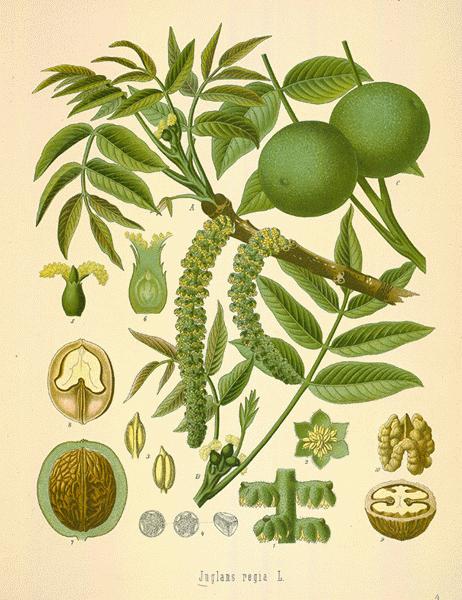
The bark and leaves of walnut were used in the treatment of skin conditions, such as eczema, and in the healing of ulcers. An infusion of the bark was used as a purgative, and green walnuts were used to expel worms.
The vinegar in which walnuts were pickled was used as a remedy for sore throats.
Warts
Onion juice was suggested as a cure for warts, as were dandelion juice, leek juice, mullein juice, rue juice and the juice of St. John's wort. An infusion of marigold, or the crushed fresh flowers of marigold, was used also as a remedy, and the warts were also rubbed night and morning with cinnamon oil in an attempt to get rid of them. Another recommended remedy was the rubbing of the warts with a raw potato, and yet another involved rubbing the warts with castor oil.
Thyme juice boiled with pepper in wine and the juice of teasel roots boiled in wine were both regarded as remedies. The juice of wheat ears was mixed with salt to form another cure for warts, and willow bark was burnt and its ashes mixed with vinegar to be applied as lotion to the warts.
A more curious cure involved tying a horse hair round the individual warts and applying spider webs, pig's blood or the juice from ants. Rubbing the wart with the blood of eels was another suggested old remedy.
Several supposed remedies involved burying whatever the wart was rubbed with, in the belief that as the buried object rotted away the wart would disappear. In one of these the wart was cut open and rubbed with a sour apple that was afterward buried. In another, a piece of meat was rubbed on the wart and buried, a stipulation being that the meat had to be stolen. Alternatively, the stolen meat could be thrown away instead of being buried when it had been rubbed on the wart.
Raw bacon was something else that could be rubbed on the wart and buried. The inside of a broad bean could also be used in this way.
Thyme juice boiled with pepper in wine and the juice of teasel roots boiled in wine were both regarded as remedies. The juice of wheat ears was mixed with salt to form another cure for warts, and willow bark was burnt and its ashes mixed with vinegar to be applied as lotion to the warts.
A more curious cure involved tying a horse hair round the individual warts and applying spider webs, pig's blood or the juice from ants. Rubbing the wart with the blood of eels was another suggested old remedy.
Several supposed remedies involved burying whatever the wart was rubbed with, in the belief that as the buried object rotted away the wart would disappear. In one of these the wart was cut open and rubbed with a sour apple that was afterward buried. In another, a piece of meat was rubbed on the wart and buried, a stipulation being that the meat had to be stolen. Alternatively, the stolen meat could be thrown away instead of being buried when it had been rubbed on the wart.
Raw bacon was something else that could be rubbed on the wart and buried. The inside of a broad bean could also be used in this way.
Wednesday, July 2, 2008
Watercress

Early herbalists recommended watercress as a remedy for poor hair growth.
Because it was high in iron it was used to treat anemia. It was also used to stimulate the appetite.
An expectorant, it was used as a remedy in the treatment of bronchitis and asthma. As a diuretic, it was used in the treatment of urinary disorders. Disorders of the liver and gall bladder were treated with it.
Watercress was also used in nervous disorders.
It was used to stimulate menstruation and increase the milk supply in nursing mothers. it was also thought to increase fertility.
Externally, watercress was used in the form of a poultice to treat wounds, boils, ulcers, cold sores and scabies. It was also used to make a lotion for hemorrhoids and rashes. A mouthwash made from it was used for the relief of toothache.
White Bryony

White bryony is sometimes known as bryony or English mandrake. It was popularly regarded as having aphrodisiac powers and was considered by the Romans to afford protection against lightning.
It was a plant that had to be used with extreme caution. The dried root was used in some folk remedies, but it is toxic and could induce vomiting and gastric pain. The berries are also poisonous.
It was used as purgative and in diseases of the respiratory system, such as bronchitis, pneumonia, influenza and coughs. Heart disorders caused by gout or rheumatism and malaria were also treated with it.
Whooping Cough
Thyme was thought to have properties that could relieve whooping cough, while an infusion of garlic rubbed on the chest was also thought to bring relief to the sufferer. Oil of cloves, sometimes combined with olive oil, was also rubbed on the chest.
Eucalyptus was used in the form of a decoction of the leaves taken internally. The oil was also put in very hot water and used as an inhalation.
Another remedy involved filling a kettle as full as possible, boiling it, adding a spoonful of carbolic acid and letting the steam fill the room. This was supposed to relieve the symptoms of whooping cough.
A mixture of ground alum and powdered sugar was recommended to be taken by the sufferer several times a day. Another mixture that was used as a remedy consisted of West Indian rum, aniseed oil and lemon juice.
There were some extremely odd old cures for whooping cough. One particularly unpleasant one involved holding a frog or toad for a few moments with its head in the mouth of the sufferer. Sometimes a fish was put into the patient's mouth and then thrown into a river, the idea being that it would take the whooping cough infection into the water with it.
A mixture of crushed wood lice and breast milk from a nursing mother taken every morning for several days was another cure and probably one that did not appeal very much to the person forced to take it. He or she would probably have preferred another cure, which involved passing the patient three times under the belly of a donkey and then passing him or her three times over the back of a donkey.
Eucalyptus was used in the form of a decoction of the leaves taken internally. The oil was also put in very hot water and used as an inhalation.
Another remedy involved filling a kettle as full as possible, boiling it, adding a spoonful of carbolic acid and letting the steam fill the room. This was supposed to relieve the symptoms of whooping cough.
A mixture of ground alum and powdered sugar was recommended to be taken by the sufferer several times a day. Another mixture that was used as a remedy consisted of West Indian rum, aniseed oil and lemon juice.
There were some extremely odd old cures for whooping cough. One particularly unpleasant one involved holding a frog or toad for a few moments with its head in the mouth of the sufferer. Sometimes a fish was put into the patient's mouth and then thrown into a river, the idea being that it would take the whooping cough infection into the water with it.
A mixture of crushed wood lice and breast milk from a nursing mother taken every morning for several days was another cure and probably one that did not appeal very much to the person forced to take it. He or she would probably have preferred another cure, which involved passing the patient three times under the belly of a donkey and then passing him or her three times over the back of a donkey.
Tuesday, July 1, 2008
Willow, White
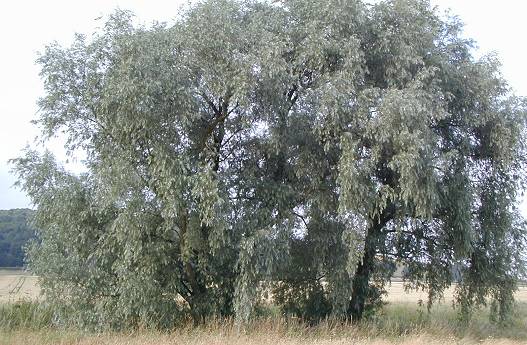
The bark and leaves of the white willow were used in herbal medicine. The bark was used to reduce fevers in some conditions and as a remedy for indigestion, dysentery, diarrhea and worms. It was used as a tonic for people recovering from illness.
Wintergreen

Oil of wintergreen was used to soothe pain, including that caused by rheumatism and arthritis. It was also used for bruises.
Taken internally wintergreen was used as a gargle.
Witch Hazel
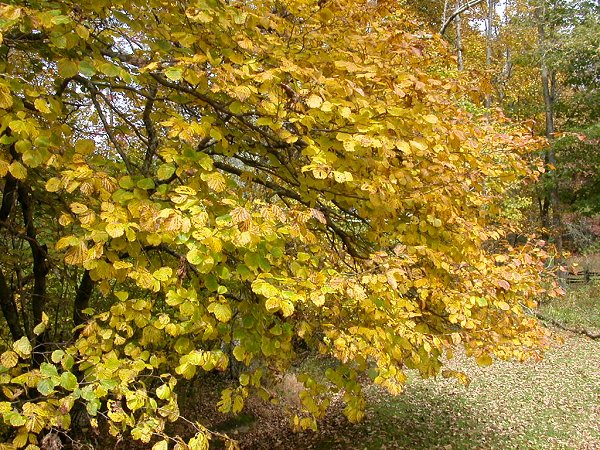
Witch hazel was used to stop both internal and external bleeding, and in the treating of hemorrhoids and heavy menstrual bleeding. It was also used to treat diarrhea and dysentery, venereal disease and tuberculosis.
However, its principal use was as an external remedy for bruises, sprains and inflammation. It was used also to treat burns, bites and stings, and varicose veins.
Subscribe to:
Posts (Atom)


